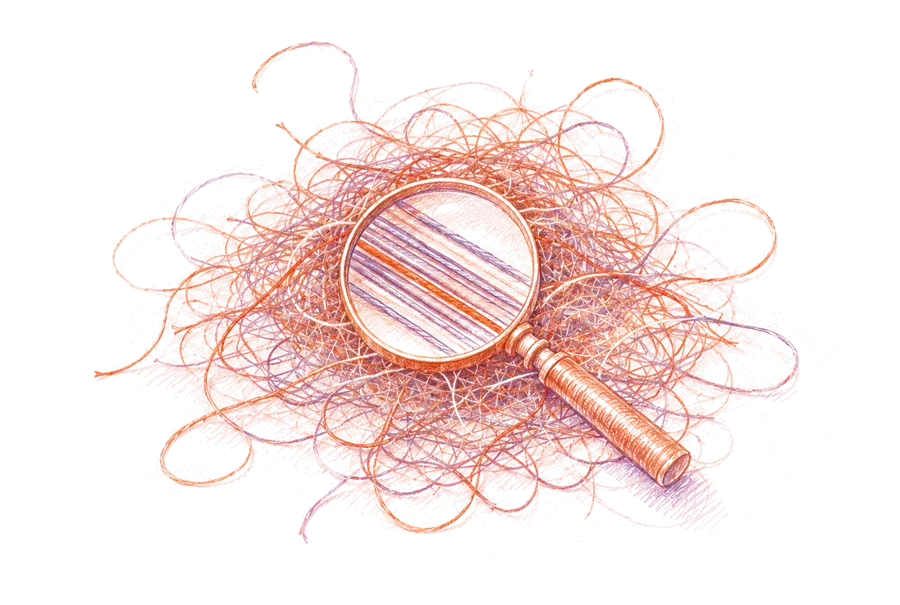
As part of the Domus Academy UNFOLD exhibition in Milan, a roundtable explored tangible ways to understand and work with the complexity of our time through design. Four international speakers each brought their own point of view. These are my notes, not transcripts.
Allison Rowe: decentralization
- Slime mold as planner. In a 2010 experiment in Tokyo, a slime mold grew a network much like the Tokyo rail system. Researchers in Toronto later repeated it with a virtual slime mold to simulate planning. Biomimicry like this brings holistic thinking to the table.
- Food security. Hawaii imports most of its food, which became a real issue during the pandemic. Ancient, community-organized farming once fed the islands from a small share of the land: decentralized, place-specific production.
- If nature drew the map. One Earth divides the world into 185 bioregions (deserts, forests, shrublands). Grow within your biome and exchange knowledge “instead of flying avocados.” Bring scale back down.
- Swarm intelligence. Bee and ant colonies show sophisticated collective behavior beyond what individuals can do. When a colony needs a new home, scouts return and dance until a decision emerges.
- Takeaway: what is our role in a decentralized system? Multiple identities, multiple potentials, collective decision-making.
Matt Webb: acts, not facts
- The poem clock. A physical clock in his house writes a new poem every minute that tells the time. Sometimes it lies about the time to make the poem work, sometimes it invents words. It’s good at some things and not at others.
- Opportunity 1: ubiquitous intelligence. If AI keeps getting twice as good, it also gets half as expensive, and so it ends up everywhere. Multimodal interfaces, going back to MIT’s “Put that there” (1980), understand pointing, glancing and indirect references. Tiny neural networks can run on very little power. What happens when our environment is intelligent, and does that feel like surveillance?
- Opportunity 2: new senses. Language models can give us senses we didn’t have: making text and prose as easy to explore as filtering images, or seeing how a narrative moves through semantic space.
- Takeaway: what used to be difficult is now easy, and what used to be easy no longer holds. Embrace the weird: get your hands dirty, be playful, and find where the material breaks. Hallucinations are part of the material.
Silvio Lorusso: against complexity
- Author of What Design Can’t Do. Talk of complexity has become a cultural practice in itself, and designers sometimes inflate visible complexity because they have an interest in it.
- Warren Weaver’s idea of organized complexity: a billiard table with millions of balls colliding.
- Disciplines are artificial compartments of knowledge, and design keeps pulling more into itself. At the same time professionals lose standing, alongside a broader distrust of experts.
- Systems diagrams can feel almost conspiratorial: they produce a sense of control over a mess.
- Chaos barely appears in design and innovation language, yet it’s a generative category, as in science fiction and horror.
- Takeaway: after Cornelius Castoriadis, the work is a compromise between fragmented, situated action in the small space you can control and a long-term vision. You are one of the balls on the billiard table.
Georgina Voss: systems ultra
- Author of Systems Ultra: Making Sense of Technology in a Complex World (Verso, 2024). She works with “boring” industrial systems: supply chains, aerospace, airports.
- Airports grew from grass fields in the 1920s into large, interlocking systems of services. They’re often called non-places, but they’re places: who is allowed to fly, who is watched, whose body or hair a scanner flags as suspicious, and how duty-free numbs passengers into not asking questions.
- Large projects like airports and nuclear plants need a disciplined flexibility, and they run over time and budget. Systems surprise you.
- Examples from the discussion: the UK Government Digital Service’s work on accessibility for different audiences, and biochemistry’s metabolic diagrams, where enzymes were drawn as little monsters.
What I took away
- Complexity exists, but how we talk about it is ideological. Be conscious of how we sell design.
- “Problem” is not a bad word: problems are concrete, accessible and don’t need to be big.
- Maybe we make ridiculous diagrams because we’re afraid of making things. Make things real that someone can use.
- Engage with complexity through praxis and local action, and with material in a way that doesn’t try to reduce it.
Speakers
- Allison Rowe: strategic design leader, formerly head of Research & Design at SPACE10
- Matt Webb: inventor and founder of Acts Not Facts
- Silvio Lorusso: writer, artist and designer; author of Entreprecariat and What Design Can’t Do
- Georgina Voss: writer, artist and educator; Reader at London College of Communication
Related: Systems thinking · Atlas of systems thinking frameworks